What should I check when choosing a stepper driver for a NEMA 23 or NEMA 34 motor?
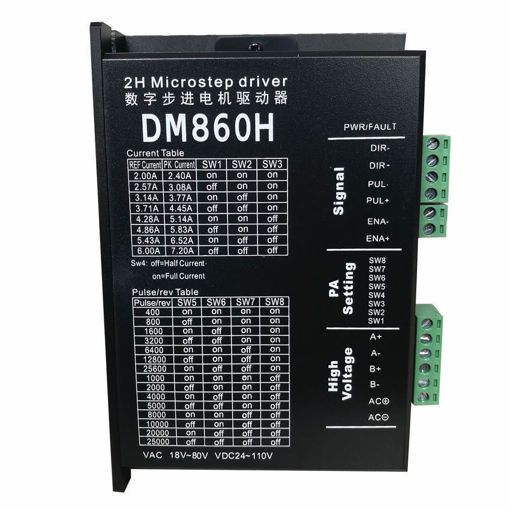
The Stepper Motor Driver DM860H gives you specific checks for a NEMA 23 or NEMA 34 system: motor compatibility, driver type, supply voltage, output-current range and required microstepping. This model accepts 24-80 V AC or 24-110 V DC, provides 2.4-7.2 A peak across 16 current settings and offers 1/1 to 1/128 microstepping across 16 settings. Confirm those values match the motor and machine electronics.
Does the Stepper Motor Driver DM860H offer useful adjustment range for different machines?
The Stepper Motor Driver DM860H offers adjustable output current and microstepping rather than a single fixed setting. Its output current is selectable from 2.4-7.2 A peak across 16 settings, while microstepping ranges from 1/1 to 1/128 across 16 settings. This gives a designer defined electrical options to assess against the motor and motion-control requirements of the intended machine.
What input voltage can the Stepper Motor Driver DM860H accept?
The Stepper Motor Driver DM860H accepts 24-80 V AC or 24-110 V DC input. These are the stated supply ranges for the driver and should be checked against the machine's available power source before installation. The product data identifies the unit as a high-voltage driver, but it does not provide wiring instructions, connector details or a recommended power-supply size.
What control inputs are isolated on the Stepper Motor Driver DM860H?
The Stepper Motor Driver DM860H provides optical isolation on its PUL, DIR and ENA inputs. These are the listed control-input signals, and the source does not specify an isolation voltage or input-current requirement. Anyone integrating the driver should therefore use the stated signal names as the compatibility reference and consult the applicable wiring documentation for electrical interface details.
What protection functions are listed for the Stepper Motor Driver DM860H?
The Stepper Motor Driver DM860H lists protection against over-current, over-voltage and over-temperature conditions. It also includes self-test and idle current reduction as stated features. The source does not describe trigger thresholds, recovery behaviour, alarm outputs or fault-reset procedures, so those details cannot be confirmed from the available product data.