What kind of project is the Stepper Motor Driver JKD5056S intended for?
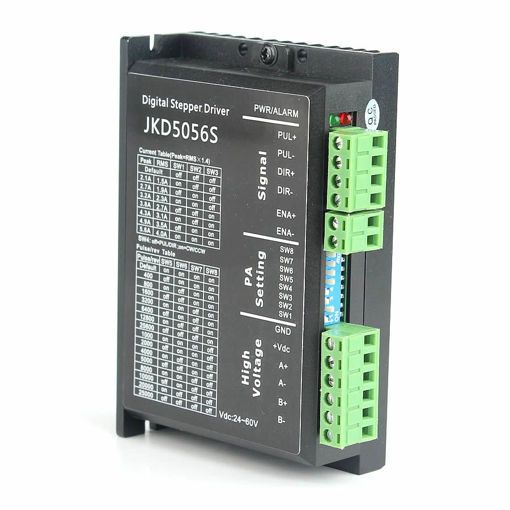
The Stepper Motor Driver JKD5056S is intended for projects using NEMA 17 or NEMA 23 stepper motors, including CNC machines, engraving equipment, 3D printers and industrial automation. It is a 2-phase digital bipolar driver, so it should be considered when those project requirements match the driver type and listed motor compatibility.
How should I compare the Stepper Motor Driver JKD5056S with other stepper drivers?
The Stepper Motor Driver JKD5056S can be compared by driver type, output-current range, input-voltage range, microstepping capability, motor compatibility and protection features. It is a 2-phase digital bipolar driver with 1.0–5.6 A peak output, 24–50 V DC input, microstepping up to 1/128, and compatibility with NEMA 17 and NEMA 23 motors.
Does the Stepper Motor Driver JKD5056S suit both NEMA 17 and NEMA 23 motors?
The Stepper Motor Driver JKD5056S is listed as compatible with both NEMA 17 and NEMA 23 stepper motors. Motor frame size alone does not specify the required operating current, so the driver’s 1.0–5.6 A peak output range should also be checked against the selected motor and the requirements of the complete system.
Can the Stepper Motor Driver JKD5056S provide fine microstepping control?
The Stepper Motor Driver JKD5056S supports microstepping up to 1/128. This states the maximum listed microstepping setting, but the available data does not specify the selectable intermediate settings, control method or resulting positioning accuracy. Those details should be confirmed before designing the control system around a particular microstep setting.
What electrical protection and signal isolation does the Stepper Motor Driver JKD5056S have?
The Stepper Motor Driver JKD5056S provides optical isolation on its PUL, DIR and ENA signals, plus over-current and over-temperature protection. The source does not state the isolation rating, protection thresholds, response behaviour or reset method, so those technical limits require confirmation if they are important to the system design.